|
My twin brother Michael and I started life in our Grandma Payne’s front room at 5 Spencer St. where we were born in 1940. At the time our Dad ‘Jack’ Lack was in the RAF and shortly after we were born, Uncle Maurice Payne, who also lived at the same address, went into the Marines. We grew up with our Mum, Ruby Lack, Grandma and Grandad, Charlotte and Alfred Payne, and Bob the Collie dog. Along the street lived Mum’s sister Aunt Lil Richardson who also had twin boys. Next door was Mr. and Mrs. Dicks. Unbeknown to us at the time, Grandma, who before marriage was a Miller, seemed to have relatives all over Burton, in Spencer, Duke, Alexander, Rosebery Streets and beyond, who acted as spies and reported back on the comings and goings of ‘Ruby’s boys’. Although very young, memories include air raid sirens, planes flying overhead in the middle of the night, gas masks on the end of the bed, collecting fallen coal from the train tracks near Finedon Station, watching the trains from the hurdy gurdy bridge near Isham, walks to Grandad’s allotment near the Rec., digging tunnels in the snow in the winter of 1947 and chases around the mysterious Hogs Hole (pronounced in Burton as Uggs Ole). When Dad was demobbed after the war, we moved to Elm Road on the new Cranford Road Estate.
 |
|
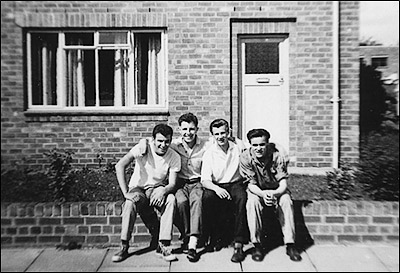
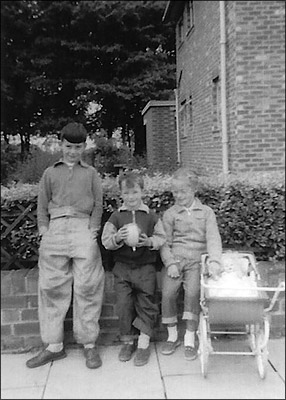
L-R: Barry Goodman, John Lack, Neil Pyburn & Billy McGrath
outside No.18 Elm Road, in the late 1950s
|
|
The Cranford Road Estate was developed as a Council Estate in 1946 after the Second World War. As a consequence many of the families were young with children below the age of 10. From memory there were about 80 homes in the estate including the Orlits*, so the number of children was significant. Click here to read about the demolition of the Orlit houses.
The children of the first occupants had great fun playing on the scaffolding and sand heaps supplied for the houses under construction. ‘Parachuting’ from the scaffold at bed room level onto the nearest sand heap was a favourite pastime until the parents found out.
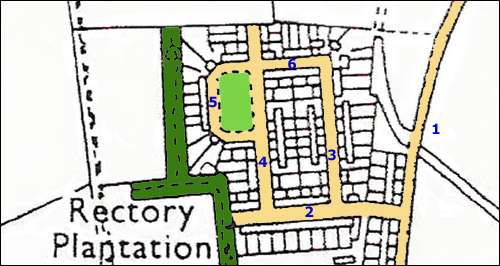
“The Green” was a grassed play area surrounded by The Crescent and Woodland Drive. It measured about 90 yards long and 40 wide. It was the playground for most of the children.
The roads around the Green comprised a ready made concrete racing track for those lucky enough to have bikes (no fear of motor cars as there were only a couple on the estate). The Green itself hosted many activities, most common being cricket and football matches. Although being smaller than the Rec, equally absorbing matches were played and children were attracted from the Avenues and other parts of Burton. On a balmy summer night a large number of kids (boys and a few girls) would be out playing cricket until 9.30 or 10 o’clock. On some occasions umpiring would be undertaken by Ray Hobbs who lived on The Crescent overlooking the Green and Arthur Knibbs who lived in
Poplar Rd.
 |
|
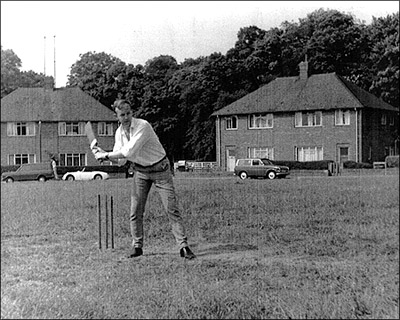
Cricket on the Green in 1971
John Byland kindly donated this photo of himself,
which was taken by Fred Wells
In the background, nos 5, 6, 7, 8 The Crescent
|
With the playing area being relatively small, the number of fielders limited the amount of runs that could be scored. It was therefore unlikely that anyone would get ten or twenty let alone 100. A four could be scored if the ball penetrated the field and landed on the road but if it landed in a garden it was out. The ball normally used was a well worn tennis ball, which was able to be bowled faster than one with fuzz on it. As the number of stumps and bat was limited, only one batsman was allowed ‘in’ at any one time. The batting crease was so well worn that a hollow would develop and any ball well pitched would shoot off in any direction. The holes for the stumps were also well formed and a closely bowled ball would sometimes make the stumps fall even though it didn’t actually hit. There were of course no bails. LBW’s were common as they depended upon the loudness of appeal from the fielders; so being struck on the legs anywhere on the playing surface stood a good chance of being out (unless you owned the bat).
The Green was the venue when the people of the Estate celebrated the Queen’s Coronation in 1952. A party was set up on the grass and running races were held for the children.
Behind the houses on the western side of the Crescent was The Spinney, a stand of Beech, Elms, Oak and Chestnut trees. In the Autumn, beech- and chestnuts were gathered on the way home from school. It was a place where ‘hide and seek’ type games could go on forever, with thick bushes that could hide anyone. In the school holidays gangs of boys would trek over to the old open cut iron ore pits near Cranford and snare rabbits. A successful catch (not often) would be taken back to the Spinney to be skinned and cooked over an open fire. Crab apples and blackberries grew in the pits and these supplemented the food ration. Despite this the results were not usually very appetizing. It should be remembered that at this time (in the late 40’s and early 50’s), many food items were still rationed and some people still went hunting rabbits. I think the Rag and Bone Man who used to walk the streets buying rabbit skins had disappeared by this time. Of course with so many trees around there were favourite climbers that could easily be scaled as well as fallen from. No one suffered serious injuries although clothing was often torn from protruding branches.
Between the Spinney and the Preston Hall were the Allotments. A footpath was well defined through the Allotments and Spinney leading to
Spinney Road. At various times of the year the path would consist of deep mud from rains or become like slippery glass slides during very cold icy weather. As young children this ‘short cut’ enabled you to go from Church St to Spinney Rd bypassing Cranford Rd which was considered to be ‘the long way round.’ At night it also avoided the Churchyard which was considered to be haunted.
At the north end of the estate were fields farmed by Mr. Attfield. They led to the railway line and the road between Barton Seagrave and Cranford. The Black Bridge
, located beyond the Windmill Cottages was a favourite direction to be taken for excursions and ‘snake hunting’. During the summer school holidays it was not uncommon for expeditions to go as far a field as Grafton Underwood or in the opposite direction to the pits on Higham Hill which contained good swimming holes.
Listed are some of the residents of the Estate and Cranford Road who used The Green as a play area; however the list is not conclusive.
John and Michael Lack, Robin and Barry Goodman, Neil and George Pyburn, David and Stewart Dunn, ‘ Pim’ Elson, ‘Red’ Carvell, Michael Coleman, Bob Jolley, David Mills, John Smith, Michael and Gerald Cook, Jimmy and John Aveling, Barry and Michael Elmore, Billy McGrath, Ray Birnie, Sean and Terry Karley, Alan and David Griffin, Davina Cooper, Jean Mason, Maureen Harrison, Pat and Christine Phillips, Tom, Pam, Doreen and Valerie Hawkins, Merle Elson, Fay Chester, Judith Pentelow, Wendy Carvell, ‘Spider’ Coleman, Ray Elliott (who had the only football on the estate), Michael Grice, Bill Comerford, David Keller, Carol Downing, Linda Bond, Joyce Stump, David Holmes, Tony Palmer, Bob Laverick, Neil Hawthorn.
Frequent visitors from other parts of Burton: Kay and Owen Brown, Michael Ridgway, John Newing, Rodney Villett, John Northern, Brian Wright, David Whitehead, Keith Cooper. Norman Baish.
With apologies to anyone we have forgotten.
| John Lack, Perth, Western Australia |
|
Michael Lack, Barton Seagrave |
Click here for more details about life on the Cranford Road Estate
Estate Gallery
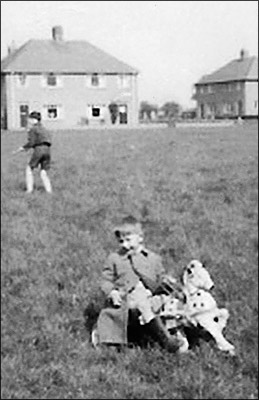
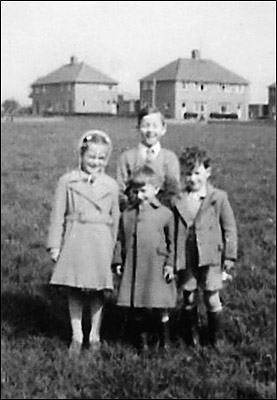
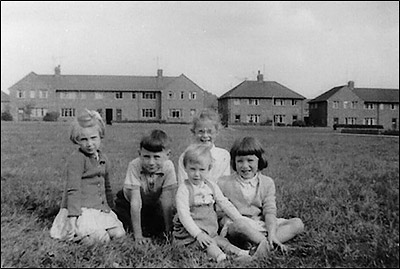
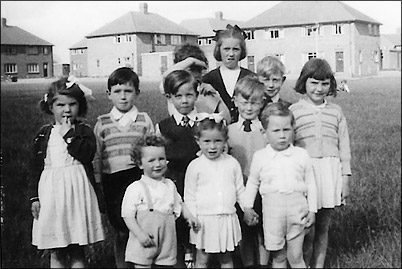
Courtesy of John Byland's kind donation, we have these pictures taken in the early years of the estate, particularly round The Crescent.
 |
 |
 |
|
1956 - David Byland
John Hobbs in the background
|
c. 1956 - Adrian Byland (centre)
with John Hobbs & Lorraine Conroy
|
c.1956 - John Byland (at back)
front - Lorraine Conroy, David Byland
& Adrian Byland
|
 |
 |
|
c. 1956
back row - Alison Hobbs, Stephen Hobbs, Lorraine Conroy
front - Nigel Jolley, Irene Jolley
|
May 1954 - John Byland's 7th birthday
back row - Pat Byland, Davina Cooper, Peter Key
middle row - Carol Vowles, John Hobbs, John Byland,
David Cooper & Sheila Ellson
front - Adrian Byland, Lorraine Conroy, Stephen Hobbs
|
 |
|
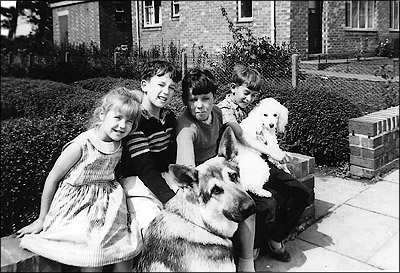
1960
(l-r) Anita Murrell, Adrian Byland, Anthony Murrell &
David Byland, with Snowy the poodle and Flash the alsatian
|
| * Orlit Houses
The whole of Spinney Road and the very first pairs of houses in Poplar Road and Woodland Drive were originally Orlit houses. The rest of the estate comprised traditional brick-built council houses of the type seen all over the country in the 1950s and 60s.
"Orlits" (as they were generally known) were houses constructed from materials made by the Orlit company of Edinburgh, Scotland. They were authorised in the 1940s-50s period as a fast-build solution to the need to provide mass housing very quickly in the years following the Second World War.
The houses were non-traditional in design, having a pre-cast concrete frame structure, externally clad with 2 inch reinforced concrete hollow blocks. The individual sections of the frame were connected with high alumina cement joints. By the 1980s, it had been identified that this type of house was prone to structural weaknesses as a result of the degrading of the high alumina cement joints, often because of condensation. Accordingly, all over the country the houses were surveyed for structural safety, and usually replaced - as happened in Burton.
|
|
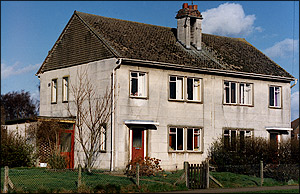 |
Nos 4 & 2 Spinney Road
This photo was taken in 1989, not long
before the demolition of the Orlits
Photo courtesy of Rob Mills
|
Click here to read about the demolition of the Orlit houses.
|